This question at hand may be one of the most hotly contested for all rotarians. Not being shy at Rotary Performance to give an opinion, we’ll answer an unequivocal yes. Depending on the circumstances, both are absolutely right. Let’s explore…
WHY PREMIX
First, why is premixing, or for that matter oil injection required on a rotary engine? Ever since the earliest days of rotary engines, controlling wear of the apex seals has been a challenge. Apex seals have a unique place in the world of internal combustion engines. Rotaries operate like a two stroke engine. Every time a face approaches the spark plugs, combustion occurs. Contrast this with a conventional 4-cycle engine where the exhaust/intake stroke is cooler and lowers the heat load on the parts. Heat builds and remains in the parts easier in a rotary engine. To add to this challenge, the apex seal travels the longest distance of all the engine parts. This whipping and wiping action causes wear issues and a propensity to chatter. Metallurgy and design helps to minimize the issue, but in the end lubrication of the surface is required. Having a thin boundary layer of oil assists the seals in remaining viable for many years. From day one, Mazda has employed oil metering to automate the oil injection process. A small amount of oil is drawn from the oil sump and metered into the fuel and air stream to provide the sacrificial lubrication required. As years have progressed, Mazda has faced a continuing challenge of providing the needed lubrication while still meeting the United States and world emission regulations. By altering the injection location, injector numbers, etc. they have kept barely ahead of the standards. There are some years of rotary cars that the injection profile was so stingy, that it easily becomes a wear issue for the engine. Unless the car is operated in a best practices method, the engine will wear itself out prematurely. In addition to this, there are operating scenarios that require more than what oil injection alone can provide. Welcome to the world of premixing.
Let’s continue with defining premixing. Premixing is the addition of sacrificial lubricant to the fuel for the engine. Well that sure sounds antiseptic. What it is to the layman is adding oil to the gas to reduce wear. What we need to explore is defining who needs to premix, how much to add, and what type oil.
WHO SHOULD PREMIX
Who needs to premix falls into three categories. One is totally obvious, but requires mention: The person who has deleted the oil metering system. There are those among us that desire a simpler under hood look, operate the car in strictly motorsports scenarios or have a system that had failed and deletion of the system was the approach taken. In these cases, premixing is absolutely vital. Permanent and irreparable damage will occur if it is not adhered to with every tank full. For this reason alone, we do not recommend ever removing the oil metering system. It is nice to have a fallback for non-sporting operation of the car.
Our next category is those that use their cars for occasional sporting uses. These are otherwise street driven cars. Frequently RX-7 and RX-8’s are used in weekend drivers training road course events (Drivers Edge, Ferrari Club, PCA, BMW Club, etc.). These events commonly feature 20 minute continuous road racing. The additional loads and heat cause wear to occur at a greater rate. In cases like these, it is ideal to add a small amount of premix to the fuel to supplement the already existing metering system. Other risk groups include occasional drag racers, drifters, street grudge matchers (shame on you), and cone bashing Auto Crossers. A little premix will go a long ways to getting every mile possible.
Our last category is the high risk cars where Mazda was particularly stingy on their oil metering. These cars are as follows:
- 1989-91 RX-7’s. This was Mazda’s first electronically metered oil injection cars. The volume of oil injection dropped to about 25% of the preceding 1986-88 models. The results were shorter engine life, especially the automatic transmission models.
- 2004-11 RX-8’s. Mazda worked hard to balance the requirements of the times. Emissions drove them to develop the first side exhaust port. Running the thinnest oil, smallest apex seals and a very small injection rate made for a self fulfilling prophecy. The automatic cars from 2004-06 were highest risk. Premixing along with a couple additional changes effectively doubles the engine life of every RX-8 engine.
HOW MUCH TO PREMIX
If the determination is that you have to premix, the obvious question is how much to add? Let’s go over a few factors. Turbo and non-turbo applications have different rates. Supplemental lubrication requires less than total premixing. Fuel types like gasoline require less than alcohol burners. Now let’s look at specifics. Under ideal conditions, a typical street operated RX-7 or RX-8 will consume a quart of oil between 1,500 and 2,000 miles. By examining this rate of ideal consumption, we can discern a recommended ratio of oil to gasoline. Let’s calculate it out. We take the miles per quart of oil and divide by an average fuel economy. For fuel consumption, 21 miles per gallon is a good average of different years and city vs. highway mileage. With the variables now known, we can bring it together. Split the miles per quart difference at 1,750 miles. Take this number and divide by 21 MPG. We now have 83 gallons of fuel consumed per quart of oil injected. Put another way, that’s 32oz of oil per 83 gallons or 0.38oz per gallon or a ratio of 330:1. That means approximately 4oz per 10 gallons is the ideal consumption rate for a street car. For the high risk groups (1989-91 RX-7’s and the 2004-11 RX-8’s), 4oz of premix per 10 gallons of gas is exactly what we recommend. Their factory injection rate is so low that you almost notice no oil consumption whatsoever.
Our next group is the weekend hot rod warrior. If you’re planning to participate in a road course event, auto cross, etc. It is recommended to supplement an already properly functioning oil metering system. Hard operation of the engine puts more stress than normally is experienced. To counteract this, a bit of premix makes for cheap insurance. This recommendation is really focused toward the 3rdGen 1993-95 RX7 crowd. Their system is excellent, especially when most cars have a PowerFC for engine management. This system allows for enhancing the injection rate through computer programming. Less premix is required for this situation so 2oz per 10 gallons is just fine. If you are participating with an RX-8 or 89-91 RX-7, then you’ll be already premixing at 4oz per 10 gallons.
Our last group is the pure race car. On these, there is no metering system. Also, they often run an alternative fuel like Ethanol, Methanol or E85. On these cars, premixing is a bit of a science experiment. Every application is a bit different. As a minimum, expect to mix 6oz per 10 gallons. On alcohol fueled cars, run an additional 2oz per 10 gallons to counteract the drying effect of the fuel. Of note, it is not uncommon for many racers to run 1oz of premix per gallon of fuel. This is a lot of oil and can foul spark plugs easily. Many begin premixing rich and back off slowly by reading the spark plug deposits. Excessive oily deposits on the plugs are a dead giveaway that the mix is too rich. Be careful to not reduce below 6oz for gas or 8oz for alcohol. Too little is far harder to recover from than too much.
WHAT TYPE OIL
Gasoline
There are three things to remember about premix oil. One is to use a premix oil specifically. “Old School” guys will remember using straight 30 weight motor oil as a premix. Please do not do this. Standard engine oil has a tendency to not mix well in the gas tank. It will stratify itself with high concentrations at the bottom of the tank. What we want to use is a product intended for the purpose. In reality, any premix will work. In practice, our favorite is synthetic premix.
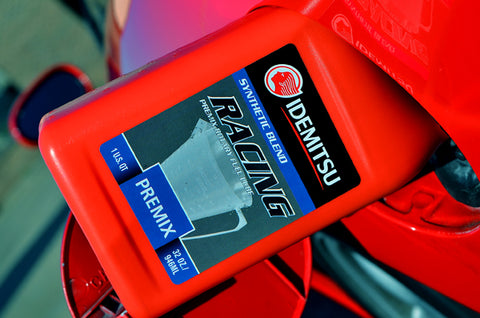
Idemitsu makes a wonderful product that is clear, consistent and relatively smoke-free. Being a synthetic, it has very consistent quality. We prefer the fact that it is clear and does not have dye. Premix that you buy at Home Depot or Lowes is made for the line trimmer and leaf blower world. It works fine, but is optimized for their world. They have a dye added to the oil to make it easier for the lawn guy to know if the fuel has been premixed. For us, the long term effect of the dye is to discolor parts (like the plastic fuel pump assembly of an RX-8). It also has a tendency to discolor clear or opaque fuel jugs. Beyond that, the oil works just fine.
Alcohol
When we are talking about alcohol, we are making recommendations for when the fuel is over 50% alcohol. Below that and the gasoline is still the majority and premix rules are still to base it on gasoline. Alcohol truly does use a different type oil. Why wouldn’t it, since it’s different for everything else as well? The lubricity of alcohol is much lower than gasoline. Even 4-cycle piston engine folks use a little top cylinder lubrication on high output alcohol applications. The standard premix of the alcohol world is castor oil. Mind you, we did not say Castrol. Castrol is a brand and castor oil is a type of oil. Castor oil is a vegetable oil from the castor bean. It has characteristics that make it the ideal oil for alcohol use. The most popular product is Klotz BeNol. It’s well recognized and not unreasonably priced. It’s sold in various quantities from half pints to quarts to gallons. Spoiler alert: This oil has a funky smell. If you’ve messed with nitro burning RC cars and airplanes, then you’ll recognize it immediately. Keep in mind, this oil is hard to find in brick and mortar stores. If you’re running alcohol consistently, you’ll need a hefty quantity of this around so you never run out.
CONCLUSION
We hope this helps to clear the air (pun intended). Premixing is not necessary for everyone, but important enough for many that a good explanation was needed. A couple of pearls of wisdom will follow to help.
- Don’t forget to premix when the engine is replaced or has a major service. The oil metering lines are usually dry until the system purges the air out. Mix it a little rich for this period, then eliminate or reduce the premix quantity to normal levels.
- Mechanical oil metering cars typically DO NOT need to premix (1988 cars and older). Their system is reliable and adjustable to optimize the rate for the engine. Keep in mind, the systems are 25+ years old and are common to be leaking so they may need to be serviced. Beyond that, they are effective.
- Many people will use a 4 ounce weed eater oil bottle to decant premix into to carry with them. In fact, they often have several prepared in a Ziploc bag. 4oz is the common volume needed for 10 gallons of gasoline. Makes it easy to add Part A and Part B.